
How to Stage Your Oakland County Home for Maximum Impact

Short answer
Prioritize decluttering, neutral colors, and strategic furniture arrangement, the core tactics that help buyers envision themselves in the space, with 82% of buyers' agents reporting staging makes visualization easier and 90% of sellers' agents staging living rooms first. Focus on kitchens, bathrooms, and curb appeal; remove personal items and excess décor to broaden appeal. Whether you DIY or hire professional help depends on your timeline and budget, but these fundamentals deliver measurable impact across all price points in Oakland County.
“Staging the living room was found to be very important for buyers (46 percent), followed by staging the master bedroom (43 percent), and staging the kitchen (35 percent).”
— National Association of Realtors, Research Group, NAR
Why Katie Rife's Staging Philosophy Works Differently in Oakland County#
Staging is the practice of preparing a home's interior and exterior so buyers can emotionally connect with it, and in Oakland County's competitive market, that connection often determines whether a property sells quickly or sits. The difference between a staged home and an unstaged one is not cosmetic: it is about buyer psychology. When a buyer walks into a cluttered, personalized space, they are mentally renovating it; when they walk into a staged space, they are already imagining their life there. That shift in perception translates into offers.
Oakland County's market has specific pressures that make staging strategy different from national norms. The county spans suburban, exurban, and rural segments, each with distinct buyer profiles. A young family in Troy has different expectations than a retiree in Ortonville. A first-time homebuyer in Pontiac is price-sensitive in ways an investor in Bloomfield Hills is not. Staging, therefore, is not a one-size-fit-all checklist, it is a targeted effort that speaks to your specific buyer pool and your home's position in the local market.
The DIY-to-Pro Spectrum: When to Stage Yourself vs. Hire a Professional#
Staging ranges from a weekend of your own effort to a full professional redesign. The decision hinges on three factors: your budget, your timeline, and your home's current condition.
DIY staging works when: your home is already reasonably clean and organized; you have several weeks before listing, and you are willing to spend a weekend moving furniture and decluttering. The cost is minimal, mostly your time and perhaps a few hundred dollars in neutral décor items. This path suits sellers in strong equity positions who can absorb a longer selling timeline if needed.
Professional staging makes sense when: your home is vacant or heavily personalized; you are in a competitive market segment, or you need to sell within a short timeframe. A professional stager brings an outside eye, knows what resonates with local buyers, and can often recoup their fee through a faster sale or a higher offer. In Oakland County's mid-to-upper market segments, professional staging frequently pays for itself.
The hybrid approach is common: you handle the decluttering and basic arrangement yourself, then hire a stager for the final polish on high-impact rooms like the kitchen, master bedroom, and living room. This splits the cost and lets you control the timeline.
How Staging ROI Differs Across Oakland County Markets#
Staging return on investment (ROI), the difference between what you spend and what you gain in sale price or speed, varies sharply by neighborhood and price point. In high-demand areas or Grosse Pointe, buyers expect move-in-ready presentation; staging there is table stakes, not a luxury. In more price-sensitive markets, a modest staging effort often yields outsized returns because fewer competing homes are staged at all.
The real measure is not the staging cost alone but the days-on-market (DOM), how long your home sits before an offer. A staged home typically reduces DOM, which lowers carrying costs (mortgage, property tax, utilities) and reduces the risk of price reductions. On a typical Oakland County sale, every week a home sits costs you money in carrying costs and negotiating leverage. Staging that cuts DOM can often pay for itself many times over.
The Core Staging Toolkit: Decluttering, Arrangement, and First Impressions#
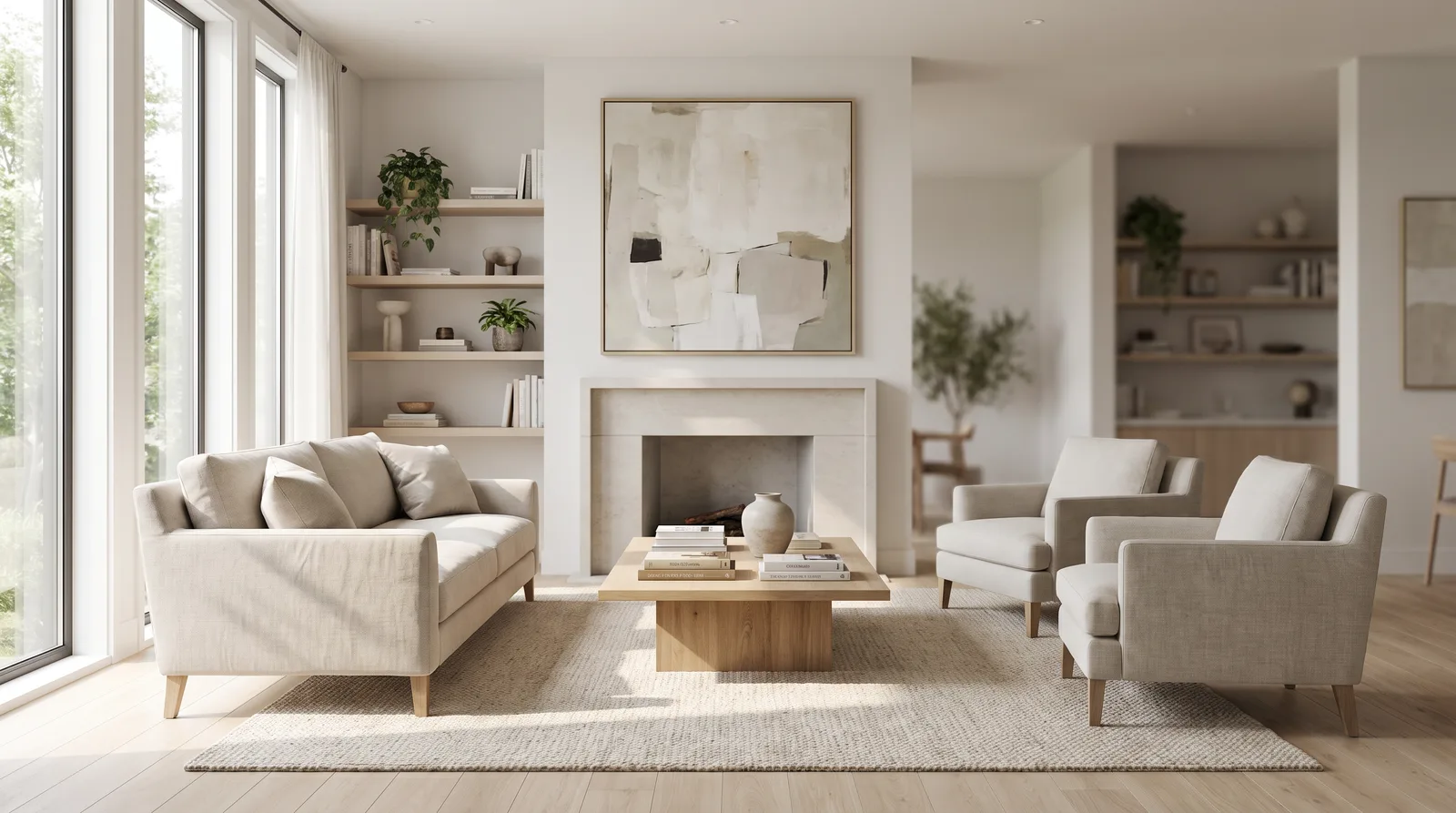
Strategic Decluttering and Furniture Arrangement for Maximum Impact#
Decluttering is the foundation of staging. A cluttered home reads as small, chaotic, and hard to imagine yourself in. The goal is to remove enough personal items and excess furniture so that each room's purpose is crystal clear and buyers can mentally place their own belongings.
The decluttering sequence:
Remove a portion of visible items. This sounds aggressive, but it works. Clear nightstands to a lamp and a small clock. Empty kitchen counters to a coffee maker and utensil holder. Remove family photos, collections, and hobby gear. Buyers need to see the bones of the room, not your life.
Depersonalize ruthlessly. Take down political signs, religious items, and sports memorabilia. Neutral does not mean sterile, it means your home does not announce your identity so loudly that a buyer cannot imagine theirs there instead.
Arrange furniture to show flow and scale. Furniture placement should create clear pathways and make rooms feel spacious. A sofa angled into a corner often makes a living room feel smaller; pulled slightly away from the wall, with a side table and lamp, it feels intentional and open. Bedroom furniture should leave adequate walking space on both sides of the bed.
Remove or replace oversized pieces. If your sectional fills the living room, consider removing it for showings or replacing it with a smaller sofa and chair. Buyers need to see the room's actual dimensions, not feel squeezed by your furniture.
Buyers are mentally furnishing the space as they walk through because this insight matters: if they cannot see the room's potential because your belongings are in the way, they move on.
Entry and Curb Appeal: Setting the First Impression#
The entry, both exterior and interior, is where staging begins and where most buyers form their first impression. Curb appeal is not optional; it is the gateway to the rest of the home.
Exterior priorities:
- Landscaping: Trim overgrown shrubs and trees. Mow the lawn. Mulch flower beds. A neat, maintained yard signals that the home has been cared for.
- Front door: Paint it a welcoming neutral or soft color if it is worn. Replace hardware if it is tarnished. A clean, attractive entry door is one of the highest-ROI improvements.
- Porch and walkway: Pressure-wash the driveway and walkway. Remove any clutter from the porch. A clean entry path is the first thing a buyer experiences.
- Lighting: Ensure the porch is well-lit. Add a few planters with seasonal flowers or greenery. Lighting and greenery signal care and warmth.
Interior entry:
The foyer or entry hall sets the tone for the entire home. It should be clean, uncluttered, and inviting. Remove shoes, coats, and mail. A small console table with a mirror and a single decorative item (a vase, a plant) is enough. The goal is to make a buyer feel welcomed, not like they are entering a lived-in home mid-week.
Living Room Staging (and Why It's Non-Negotiable)#
According to the National Association of Realtors, 90% of sellers' agents staged the living room, the most commonly staged room. This is not coincidence. The living room is where buyers imagine themselves relaxing, entertaining, and spending time. It is the emotional center of the home.
Living room staging checklist:
- Furniture arrangement: Create a conversation area. Sofa and chairs should face each other or a focal point (fireplace, TV). Remove excess seating.
- Lighting: Lamps on side tables, overhead lighting soft and warm. Avoid harsh overhead lights alone.
- Focal point: If there is a fireplace, stage it as a feature, a few books, a candle, a small plant. If not, a large mirror or artwork can serve as a visual anchor.
- Depersonalization: Remove family photos, personal collections, and hobby items. Neutral artwork (abstract, landscape, botanical) works well.
- Flooring: Rugs define the space and add warmth. A rug under the seating area makes the room feel intentional.
A staged living room tells a story: this is where you will relax, read, watch movies, and spend time with people you love. A buyer who can see themselves in that story is far more likely to make an offer.
Light, Color, and Depersonalization: The Sensory Foundation of Staging#
Lighting Optimization for Buyer Perception#
Lighting shapes how a buyer perceives space, mood, and cleanliness. Poor lighting makes a home feel dark, small, and uninviting. Good lighting makes it feel open, warm, and well-maintained.
Lighting strategy:
- Layer the light. Use a combination of overhead, task (desk lamps, reading lights), and accent lighting (wall sconces, candles). Layered lighting feels intentional and warm.
- Maximize natural light. Open all curtains and blinds during showings. Clean windows thoroughly. Natural light is the single most powerful tool in staging.
- Replace dim bulbs. Use warm white LED bulbs in most fixtures. Avoid cool white bulbs which feel clinical. Warm light is more inviting.
- Highlight key areas. Use accent lighting to draw attention to architectural features, a fireplace, built-in shelving, or artwork.
- Avoid harsh overhead lights alone. If your home relies on a single overhead fixture per room, add table lamps and wall sconces. Harsh lighting makes a space feel cold and institutional.
Lighting is often the cheapest staging investment with the highest return. A few new lamps and bulbs can transform a dark room into one that feels open and welcoming.
Neutral Color Palettes and Depersonalization Strategies#
Color is a powerful psychological tool. Bold, personal colors (deep jewel tones, bright accent walls, bold patterns) can alienate buyers who do not share your taste. Neutral palettes, soft grays, warm whites, beiges, and soft greens, create a blank canvas that allows buyers to imagine their own style.
Depersonalization strategy:
- Paint bold accent walls neutral. If you have a deep teal or burgundy wall, consider painting it a soft gray or warm white. This is one of the highest-impact, lowest-cost moves in staging.
- Remove personal collections. Sports memorabilia, hobby gear, and collections should be packed away or stored. These items anchor the home to your identity, not a buyer's.
- Swap out personal artwork. Family photos and personal art should come down. Replace them with neutral, universally appealing artwork, landscapes, abstracts, botanicals.
- Neutral textiles. Bedding, curtains, and throw pillows should be neutral or soft, muted colors. Avoid bold patterns or colors that might clash with a buyer's vision.
- Minimize religious and political items. These are deeply personal and can alienate buyers who do not share your beliefs.
The goal of depersonalization is not to make your home feel sterile, it is to make it feel like a blank canvas. A buyer should be able to imagine their own life, their own style, and their own family in the space.
Kitchen and Bathroom Staging: Where ROI Concentrates#

Kitchen Staging Priorities and Budget Tiers#
The kitchen is the second-most-staged room after the living room, and for good reason: it is where buyers spend time, and it is expensive to renovate. Staging a kitchen well signals that the home has been maintained and cared for.
High-impact, low-cost moves:
- Clear countertops. Remove small appliances, utensil holders, and clutter. Keep only a coffee maker, utensil holder, and perhaps a small plant or decorative item. Clear counters make the kitchen feel larger and more open.
- Clean and organize cabinets. Open a few cabinet doors during showings to reveal organized, clean interiors. Remove excess items. Buyers peek inside cabinets; organized interiors signal care.
- Update hardware. If cabinet hardware is dated or tarnished, replace it with modern, neutral hardware. This is a quick, inexpensive update that modernizes the look.
- Lighting. Ensure the kitchen is well-lit. Add under-cabinet lighting if possible, or ensure overhead lights are bright and warm.
- Backsplash and sink. A clean, neutral backsplash (or no backsplash) works best. Ensure the sink is spotless and polished.
Mid-range improvements (if budget allows):
- Paint cabinets. If cabinets are dated, painting them a neutral color (soft white, gray, or natural wood tone) can modernize the kitchen without a full remodel.
- New countertops or refinishing. If counters are worn, refinishing or replacing them can dramatically improve the kitchen's appearance.
- Flooring. If the floor is dated or stained, refinishing or replacing it can make a huge difference.
What not to do:
- Do not attempt a full kitchen remodel for staging. The ROI is typically poor. Focus on cleanliness, organization, and small updates that signal care.
- Do not leave appliances dirty or outdated-looking. If they are visibly worn, clean them thoroughly or consider replacing them if the budget allows.
Bathroom Staging Essentials#
Bathrooms are intimate spaces where buyers assess cleanliness and maintenance. A clean, well-organized bathroom signals that the home is well-maintained.
Bathroom staging checklist:
- Deep clean. Scrub the toilet, sink, and shower/tub until they shine. Grout should be clean. Mirrors should be spotless. Bathrooms are where buyers judge cleanliness most harshly.
- Declutter. Remove personal care items, medications, and excess towels. Keep only a few rolled towels, a soap dispenser, and perhaps a small plant or candle.
- Lighting. Ensure the bathroom is well-lit. Replace dim bulbs with bright, warm white bulbs. A well-lit bathroom feels clean and spacious.
- Neutral décor. Remove personal items. A simple shower curtain in white or neutral color works best. Avoid bold patterns or colors.
- Flooring and grout. If grout is stained or discolored, clean it thoroughly or consider having it professionally cleaned. Stained grout signals poor maintenance.
- Hardware and fixtures. If faucets or hardware are tarnished or dated, consider replacing them. Polished, modern hardware updates the space.
A staged bathroom should feel like a spa, clean, calm, and inviting. A buyer who sees a spotless bathroom is more confident that the entire home has been well-maintained.
Budget-Conscious and Remote-First Staging Alternatives#
Renting vs. Buying Staging Furniture: Cost-Benefit Analysis#
Not every home needs furniture rental. The decision depends on whether your home is vacant, heavily personalized, or missing key pieces.
Rent staging furniture when:
- Your home is vacant and feels empty and cold. Rental furniture fills the space and helps buyers envision themselves living there.
- Your existing furniture is outdated, worn, or does not fit the home's style. Rental pieces are typically modern and neutral.
- You need to stage quickly and do not have time to source and arrange your own pieces.
Buy or use your own furniture when:
- Your home is already furnished with decent, neutral pieces. Moving and arranging what you have is often enough.
- You are on a tight budget. Your own furniture costs nothing to stage with.
- You plan to keep the furniture after the sale. Rental is a sunk cost; your own pieces have residual value.
Cost reality: Staging furniture rental typically runs from a few hundred to a few thousand dollars depending on the scope and duration. This is a real cost, but it must be weighed against the potential gain: a faster sale, a higher offer, or both. In Oakland County's competitive segments, the ROI often justifies the expense. In slower markets, DIY staging with your own furniture may be the smarter move.
Virtual Staging and 3D Visualization for Oakland County Buyers#
Virtual staging uses digital tools to add furniture, décor, and even structural changes to photos or videos of a home. It is particularly useful for vacant homes, homes with dated décor, or homes being marketed to remote buyers.
How virtual staging works:
- A photographer takes images of empty or cluttered rooms.
- A designer uses software to digitally add furniture, paint colors, flooring, and décor.
- The result is a photorealistic image showing how the space could look furnished and styled.
When virtual staging makes sense:
- Your home is vacant. Virtual staging fills the space and helps remote buyers envision themselves there.
- You are marketing to out-of-state or international buyers who cannot visit in person.
- You want to show multiple design options (e.g., "this bedroom as a master suite" vs. "as a home office").
- Your home has dated décor that is hard to photograph well. Virtual staging can modernize the look without physical changes.
Limitations:
- Virtual staging does not replace physical staging for in-person showings. Buyers who visit still need to see a clean, organized, well-lit home.
- Virtual staging is most effective when paired with high-quality photography. Poor photos, even virtually staged, do not convert.
- Virtual staging can feel artificial if overdone. Subtle. Realistic staging is more effective than obvious digital manipulation.
Virtual staging is a tool, not a replacement for physical staging. In Oakland County's market, where many buyers still prefer in-person viewings, physical staging remains the priority. Virtual staging is best used to enhance online listings and reach remote buyers.
Seller Psychology: Emotional Detachment and Letting Go During Staging#
Staging requires sellers to depersonalize their homes, which is emotionally difficult. Your home is not just a property, it is a repository of memories, identity, and emotional attachment. Asking you to remove family photos, pack away collections, and neutralize colors feels like erasing yourself.
Seller psychology becomes critical because the most common staging failure is not a lack of effort, it is a seller's inability to emotionally detach from the home. A seller who cannot let go of personal items, who insists on keeping family photos on display, or who refuses to paint over a bold accent wall is sabotaging their own sale.
How to manage emotional detachment:
- Reframe the goal. You are not erasing your identity; you are creating a blank canvas for a buyer to imagine their own life. This is a temporary, strategic move, not a permanent loss.
- Pack personal items in advance. Before staging, box up family photos, collections, and personal items. Store them elsewhere. Out of sight, out of mind makes it easier to let go.
- Focus on the financial outcome. A staged home typically sells faster and for more money. That financial gain is the reward for the emotional effort of depersonalization.
- Hire a professional if needed. If you cannot emotionally detach, a professional stager can do it for you. They have no emotional attachment and can make ruthless decisions about what stays and what goes.
Seller psychology is real, and it is often the invisible barrier between a home that sells well and one that languishes. Acknowledging this barrier and actively managing it is part of the staging process.
Common Oakland County Staging Mistakes and How to Avoid Them#
Over-Personalizing vs. Under-Staging: Finding the Balance#
The most common staging mistake is leaving too much personal identity in the home. Family photos on every wall, hobby gear visible, bold colors, and personal collections all signal that this is someone else's home, not a blank canvas for a buyer.
The second mistake is under-staging, doing so little that the home still feels cluttered or dated. A home that is merely "clean" is not the same as a home that is staged. Staging requires intentional arrangement, depersonalization, and enhancement.
The balance:
- Remove a portion of visible items and personal décor.
- Arrange furniture to show flow and scale.
- Neutralize bold colors and personal style.
- Enhance lighting, cleanliness, and curb appeal.
- Keep the home feeling lived-in and warm, not sterile or empty.
A well-staged home feels inviting and open, not cold or impersonal. It is a home that a buyer can imagine themselves living in, not a museum or a showroom.
Region-Specific Pitfalls in Oakland County Markets#
Oakland County has specific market dynamics that create staging pitfalls unique to the region.
Pitfall 1: Over-staging for the neighborhood. In more price-sensitive markets (Pontiac, Waterford, Hazel Park), over-staging can backfire. Buyers in these segments expect a home that is clean and organized, but excessive staging can feel inauthentic or make them question what is being hidden. Stage appropriately for your neighborhood and buyer profile.
Pitfall 2: Ignoring seasonal factors. Oakland County winters are long and dark. A home shown in January needs extra lighting and warmth to feel inviting. In summer, buyers are drawn to outdoor spaces. Stage accordingly, emphasize outdoor living in summer, cozy interiors in winter.
Pitfall 3: Underestimating the importance of the garage and basement. Oakland County homes often have finished basements and garages. Buyers expect these spaces to be clean and organized. A cluttered garage or basement signals poor maintenance of the entire home.
Pitfall 4: Neglecting curb appeal in suburban markets. In suburban Oakland County neighborhoods; curb appeal is critical. A well-maintained exterior signals that the home has been cared for. A neglected yard, driveway, or landscaping can kill a sale before a buyer steps inside.
Pitfall 5: Staging for your taste, not the buyer's. A bold, personalized aesthetic might appeal to you but alienate the broader buyer pool. Neutral staging casts a wider net and appeals to more buyers.
Measuring Impact: Staged vs. Unstaged Comparables and Market Data#
What 82% of Buyers' Agents Know About Staging Effectiveness#
According to the National Association of Realtors, 82% of buyers' agents said staging a home made it easier for a buyer to visualize the property as a future home. This is not a marginal effect, it is a dominant factor in buyer perception and decision-making.
What does this mean in practice? A staged home is not just cleaner or more organized, it is fundamentally easier for a buyer to imagine themselves living in it. When a buyer can mentally place their own furniture, their own family, and their own life in a space, they are more likely to make an offer. When they cannot, they move on.
Your staging strategy should be shaped by this insight, because every staging decision, removing personal items, arranging furniture, optimizing lighting, depersonalizing colors, serves one purpose: making it easier for a buyer to see themselves in the home.
Interpreting Oakland County Sales Data: Staged Home Outcomes#
Measuring the ROI of staging is difficult because you cannot run a controlled experiment (you cannot sell the same home twice, once staged and once unstaged). However, comparing staged homes to unstaged comparables in the same neighborhood and price range offers insight.
What to measure:
- Days on market (DOM). Staged homes typically spend fewer days on the market than unstaged comparables. A meaningful reduction is common; in competitive segments, the difference can be larger.
- Sale price relative to list price. Staged homes often sell closer to asking price or above it, while unstaged homes may require price reductions.
- Offer velocity. Staged homes often receive multiple offers more quickly than unstaged comparables.
- Carrying costs. Every day a home sits on the market costs money in mortgage, property tax, utilities, and insurance. A staged home that sells faster saves thousands in carrying costs.
How to interpret your own data:
If you are selling in Oakland County, ask your agent for comparable sales data in your neighborhood. Look at homes similar to yours in size, condition, and price. Compare the DOM and sale prices of homes that were staged vs. unstaged. This will give you a realistic sense of the staging ROI in your specific market segment.
In strong markets (Bloomfield Hills, Grosse Pointe, Troy), staging is nearly universal and the ROI is harder to measure because most homes are staged. In slower markets, staging can be a significant differentiator.
Real estate discipline exists precisely to close the gap between a home's actual condition and a buyer's perception of it. Staging is one of the most direct, cost-effective tools in that discipline. It works because it addresses buyer psychology directly: it makes a home easier to imagine yourself in, and that ease translates into offers.
Your Next Move: Staging Readiness Checklist#
Before you list, assess your home against these staging priorities. This is not a pass-fail test, it is a roadmap for where to focus your effort and budget.
Curb appeal: Is your landscaping neat? Is the front door welcoming? Is the driveway and walkway clean? If not, prioritize these first.
Decluttering: Can you remove a portion of visible personal items and excess furniture? Start with the living room, kitchen, and master bedroom.
Lighting: Are all rooms well-lit with warm, bright bulbs? Do you need to add lamps or fixtures? Test this at different times of day.
Neutral colors: Are there bold accent walls or personal artwork that need to come down? Prioritize the living room and master bedroom.
Kitchen and bathrooms: Are these spaces spotless and organized? These rooms drive buyer perception of maintenance more than any other.
Furniture arrangement: Does your furniture show the room's flow and scale, or does it crowd the space? Rearrange to open up pathways and create conversation areas.
Depersonalization: Have you packed away family photos, collections, and hobby gear? These should be stored, not on display.
If you answer "no" or "needs work" to more than three of these, staging is your priority. If you answer "yes" to most, you are ready to list.
Buying or selling in Oakland County? Work with a local agent who knows the market inside out and can guide you through staging decisions specific to your neighborhood, buyer profile, and price point. Staging is not a luxury, it is a strategic investment in your sale's speed and price. The data backs it up, and the buyers' agents know it.
| Staging Approach | Best When | Cost | Timeline | Best For |
|---|---|---|---|---|
| DIY Staging | Home is clean and organized; several weeks available before listing | Minimal, mostly your time plus a few hundred dollars in décor | Flexible; several weeks | Sellers in strong equity positions who can absorb longer selling timeline |
| Professional Staging | Home is vacant or heavily personalized; competitive market or quick sale needed | Higher upfront cost, often recouped through faster sale or higher offer | Short timeframe; immediate results | Mid-to-upper Oakland County market segments where staging frequently pays for itself |
| Hybrid Approach | You want to control some work and costs while getting professional polish on high-impact areas | Moderate, splits cost between your labor and professional service | Medium; you declutter on your own, stager finalizes key rooms | Balances budget and timeline while maximizing impact in kitchen, master bedroom, and living room |
| Staging Priority | Action Items | Expected Outcome |
|---|---|---|
| Strategic Decluttering | Remove substantial visible items; clear nightstands and kitchen counters; eliminate personal collections; depersonalize political, religious, and hobby items | Rooms appear larger and more spacious; buyers can mentally furnish and imagine their own life in the space |
| Furniture Arrangement | Create clear pathways; angle sofas away from walls; ensure adequate walking space on both sides of bed; remove or replace oversized pieces | Showcases room's true dimensions and flow; prevents buyers from feeling squeezed or claustrophobic |
| Curb Appeal & Entry | Trim landscaping; paint front door; replace tarnished hardware; pressure-wash driveway and walkway; maintain lawn and mulch flower beds | Sets positive first impression; signals home has been well-cared-for; highest-ROI exterior improvement is attractive entry door |
| Days-on-Market Reduction | Staging reduces time home sits before offer by addressing presentation across all high-impact rooms | Lowers carrying costs (mortgage, property tax, utilities); reduces risk of price reductions; improves negotiating leverage |
| Tax Type | Applicability Threshold | Rate |
|---|---|---|
| State Real Estate Transfer Tax | $100 or more in property value | $3.75 for every $500 or part of it |
| County Real Estate Transfer Tax | $100 or more in property value | $0.55 for every $500 or part of it |
Frequently Asked Questions
What is staging a home for sale in Oakland County?
Staging is preparing a home's interior and exterior so buyers emotionally connect with the property. In Oakland County's competitive market, staging shifts buyer perception from mentally renovating a cluttered, personalized space to already imagining their life there, a psychological shift that translates directly into faster sales and higher offers.
How much can staging reduce the time a home sits on the market in Oakland County?
While staging specifically reduces days-on-market (DOM) by making homes more appealing, 82% of buyers' agents reported that staging made it easier for buyers to visualize the property as a future home, according to the National Association of Realtors. This enhanced visualization typically translates to faster sales and lower carrying costs, mortgage, property tax, and utilities, making staging a cost-effective investment for Oakland County sellers.
What percentage of real estate professionals say staging impacts buyer perception?
According to the National Association of Realtors, 82% of buyers' agents said staging a home made it easier for a buyer to visualize the property as a future home, underscoring staging's measurable impact on buyer decision-making.
Which rooms should be prioritized when staging an Oakland County home?
The living room is the most commonly staged room among sellers' agents at 90%, but high-impact rooms prioritized in staging include the kitchen, master bedroom, and living room. These areas typically offer the greatest ROI when addressing professional staging or hybrid-approach polishing.
Does staging ROI vary across different Oakland County neighborhoods?
Yes, staging ROI varies sharply by neighborhood and price point. High-demand areas like Bloomfield Hills expect move-in-ready presentation, making staging essential. In price-sensitive markets, modest staging effort yields outsized returns because fewer competing homes are staged at all, giving your property distinct advantage.
How should I arrange furniture during staging to maximize perceived space?
Pull sofas slightly away from walls with a side table and lamp to create intentional, open flow rather than cramped corners. Ensure adequate walking space on both sides of beds. Remove or replace oversized furniture that fills the room, allowing buyers to see the space's true dimensions and imagine their own belongings there.
Sources
- HUD - HUD (2001-11-20)
- Michigan - Michigan (2023-05-19)
- Michigan - Michigan (2025-06-30)
- Archives - Archives (2021-09-30)
- HUD - HUD (2022-09-30)
- State of Michigan - State of Michigan (2025-04-11)
- www.nar.realtor (via Perplexity sonar-pro) - NAR (2026-09-01)